
Are We Humble Enough? Cultural Humility Matters.
Subcategories
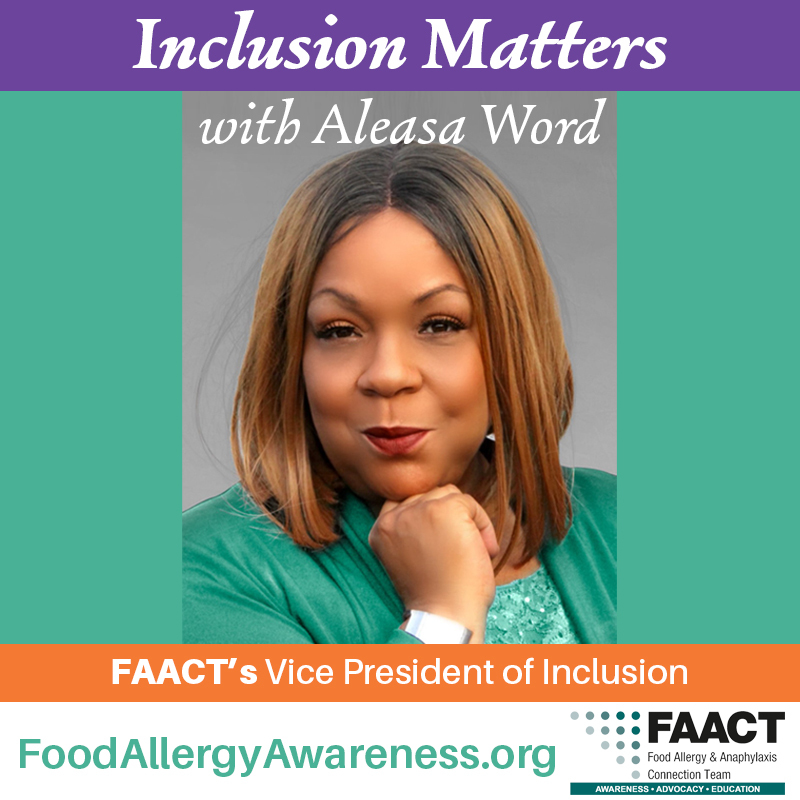
Are We Humble Enough? Cultural Humility Matters.
by Aleasa Word, FAACT Vice President of Inclusion Initiatives
March 2026
Food allergy management is most often framed as a medical issue, yet it lives inside culture as well. It lives in kitchens, religious traditions, family gatherings, immigration stories, language, socioeconomic realities and the path of daily survival.
Over the years, I’ve written about differences, but we cannot discuss differences nor similarities properly without the inclusion of cultural humility. It’s never been JUST about FOOD!
Cultural Humility Defined
You may be asking what I mean by “cultural humility.” It’s different from cultural competence. When we are culturally competent, it suggests we have learned enough from another culture to generally understand that culture. Cultural humility, on the other hand, recognizes that we never fully arrive at cultural competency—it is always a learning experience in progress. It requires ongoing self-reflection, curiosity, and a willingness to acknowledge that we don’t know what we don’t know!
Cultural humility asks questions:
- What assumptions am I making in this moment?
- What have I experienced that has shaped my views on food safety?
- Where might I not see things as clearly as I should?
- How do I respond when someone’s lived experience differs drastically from mine?
When we are thinking about cultural humility, it helps shift us from judgment about others to curiosity. In the food allergy community, that type of shift is important.
Your Cultural Lens
Now that we understand cultural humility, the next step is to remind ourselves that everyone managing food allergies is navigating the journey through their own cultural framework.
For some families, food is central to religious practices, traditional meals/recipes, a grandparent’s legacy, and showing respect towards others through food. However, language barriers can cause a disconnect in families and access to specialty allergen-friendly foods can become cost prohibitive. Other families may have communities or systems in places that are more food allergy friendly or aware. They may feel safer when engaging in social advocacy efforts, reading labels, working with schools that are responsive, or working with healthcare systems they actually trust. These differences aren’t about effort, but they are about context.
Cultural humility is that little voice in the background that invites us to acknowledge that how someone manages food allergies is influenced by how they live, what they have access to, and how their community operates.
The Elephant in the Room
Sometimes cultural differences create tension. One family may feel frustrated that another does not manage allergies in the same way. A school administrator may feel defensive when asked to adjust long-standing food traditions. A community member may struggle to understand why certain accommodations are non-negotiable.
Cultural humility does not require agreement with every practice. But it does require pausing judgment long enough to understand context.
It begs the questions: What might I be missing? What historical or cultural meaning is attached to this food? How can we protect safety without dismissing identity?
When we realize that discomfort does not equal failure, it opens a doorway to a deeper understanding of these questions.
What We Manage
A family managing food allergies may also be navigating intersectionality. This refers to the way multiple aspects of identity overlap and shape experience, race, ethnicity, language, disability status, gender, socioeconomic status, faith tradition, immigration status, and more.
This family may also be navigating limited access to healthcare, medical bias, housing or food insecurity, food deserts, cultural exclusion, immigration-related stress, or religious dietary laws. Safety does not look the same for everyone, and especially those navigating intersecting needs. Finding allergy-friendly alternatives can be cost prohibitive. Culturally specific dishes may not have labels, creating fear, uncertainty, and tension in the family. A child of color may face allergy minimization and racial bias, all while being expected to go through life as if all is well.
When we fail to consider intersectionality, we risk oversimplifying safety concerns. Cultural humility reminds us that expecting people to just advocate harder is not always enough.
Strengthening Our Cultural Humility
So how do we increase our cultural humility? One way is through increasing our emotional intelligence. Emotional intelligence strengthens cultural humility. It requires:
- Self-awareness through recognizing our own biases and triggers.
- Self-regulation through responding calmly when we feel challenged.
- Empathy through understanding lived experiences different from our own.
- Social awareness through reading cultural context.
- Relationship management through navigating conflict respectfully.
In food allergy spaces, emotions can run high. When safety feels threatened, fear can quickly become anger. Cultural humility ensures those emotions do not become a dismissal of safety and the way we feel.
If you are invested in improving your cultural humility, try listening before giving advice. Ask open-ended questions so you are working through a lens of curiosity. Avoid comparing your family’s approaches to others—this is a time to learn. Think about financial accessibility when you are making recommendations to others. Social awareness matters. Socioeconomic differences and language barriers do exist. Emotional responses are also something you will need to get familiar with, but with enough time and effort, you’ll find yourself making progress on the cultural humility trail.
At its core, our community understands the importance of safety. Safety is not always physical—it can be emotional, relational, and cultural. When we are open to learning, we can embrace all of this. When you approach situations with humility, trust builds more easily and solutions can come about faster.