Navigating Treatment Choices
Subcategories
Navigating the Food Allergy Treatment Decision Process
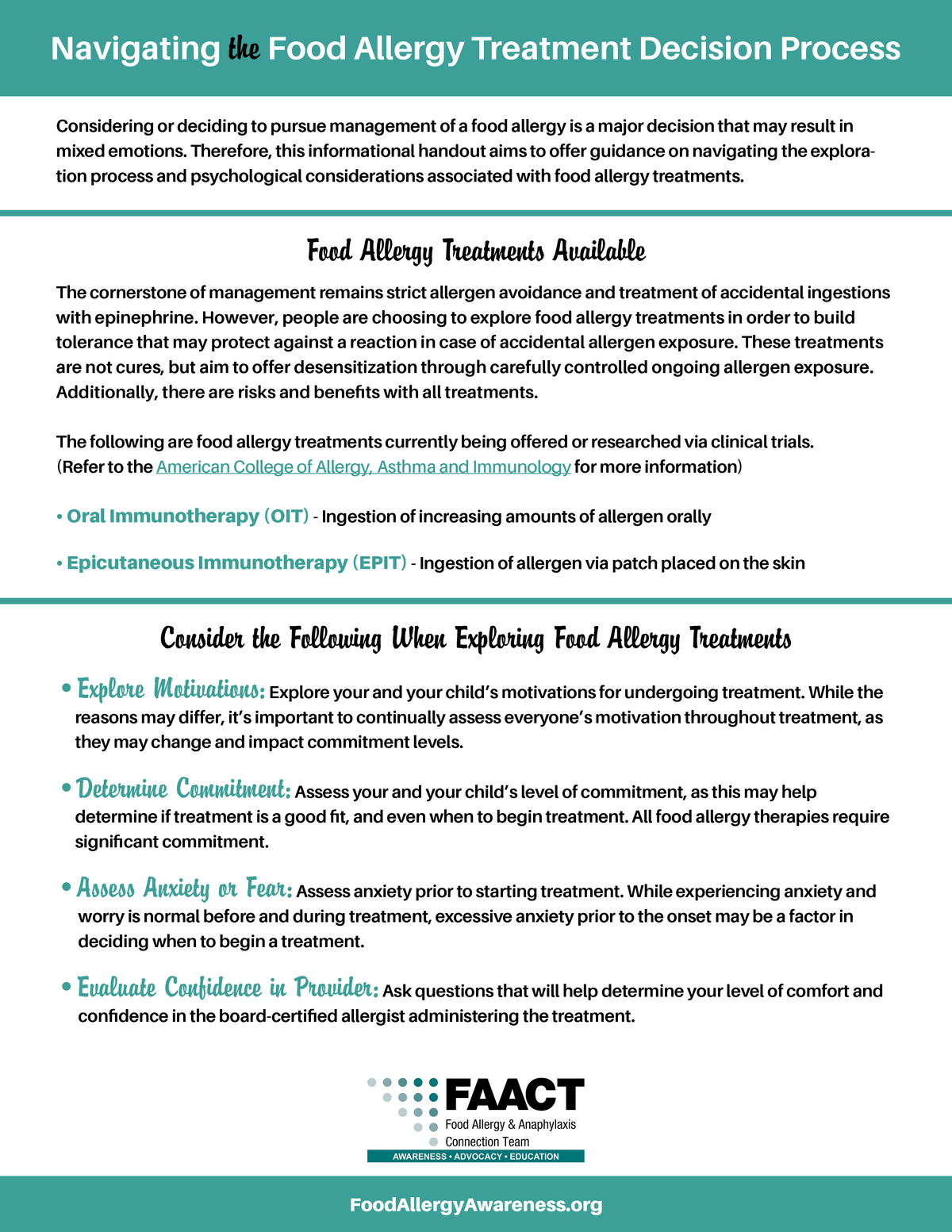
Considering or deciding to pursue management of a food allergy is a major decision that may result in mixed emotions. Therefore, this informational handout aims to offer guidance on navigating the exploration process and psychological considerations associated with food allergy treatments.
Food Allergy Treatments Available
Treatments for food allergies are evolving, and while there isn't yet a complete cure, several approaches are available to manage and potentially reduce the severity of allergic reactions through carefully controlled ongoing allergen exposure. There are risks and benefits with all treatments.
Here’s a summary of the current food allergy treatment options:
1. Avoidance and Emergency Management (current standard of care for food allergies)
The most important way to manage a food allergy is to avoid the food that causes the reaction and to be prepared to act quickly if a reaction occurs. Even with careful planning, accidental exposures can happen, so emergency readiness is essential.
Avoiding the Allergenic Food
Strict avoidance helps prevent allergic reactions and is the foundation of food allergy care.
This includes:
-
- Reading all food labels every time, even for familiar products.
- Avoiding cross‑contact during food preparation and serving.
- Asking questions when eating at restaurants, schools, or social events.
- Sharing your food allergy action plan with caregivers, teachers, and family.
- Following guidance from your allergy specialist.
Avoidance reduces risk, but it does not eliminate it completely—so emergency treatment must always be available.
Emergency Treatment for Allergic Reactions
Some food allergy reactions can be severe or life‑threatening (called anaphylaxis). Epinephrine is the first and most important treatment for these reactions.
Key points about epinephrine:
-
- It works quickly and can save lives.
- It should be used at the first signs of a serious allergic reaction.
- Delaying epinephrine can make reactions worse.
- Antihistamines (such as Benadryl®) do not treat anaphylaxis.
People with food allergies are generally advised to:
-
- Carry two FDA‑approved epinephrine products at all times (such as Auvi‑Q®, EpiPen®, or nasal spray neffy®).
- Know when and how to use them.
- Review their emergency action plan regularly.
Epinephrine is safe and should be used right away if anaphylaxis is suspected. After using epinephrine, follow your Allergy and Anaphylaxis Emergency Plan. You may need to seek emergency medical assistance.
2. Oral Immunotherapy (OIT)
Oral immunotherapy (OIT) is a treatment where a patient consumes very small amounts of an allergenic food and slowly increases the amount over time, under medical supervision to build tolerance.
What OIT does:
-
- Helps the body react less strongly to the food they are allergic to.
- Lowers the risk of severe reactions from accidents.
- Requires daily dosing to keep protection.
Important limits:
-
- OIT does not cure food allergy.
- Patients must still avoid the food.
- Epinephrine is still required.
- Reactions during treatment are common.
Other foods may be treated in special allergy clinics.
3. Epicutaneous Immunotherapy (EPIT)
Epicutaneous immunotherapy (EPIT) uses a patch placed on the skin that delivers tiny amounts of food protein.The allergen is absorbed through the skin to desensitize the immune system.
How EPIT works:
-
- The food protein is absorbed through the skin.
- The patient does not eat the food.
- Most side effects are mild skin irritation.
Current status:
-
- Studied mostly for peanut and milk allergy.
- Helps raise tolerance but less than OIT.
- Not yet FDA‑approved.
EPIT may be an option for young children or for people who cannot tolerate oral therapy.
Clinical trials are ongoing, with some promising results, particularly for peanut allergies.
4. Sublingual Immunotherapy (SLIT)
Sublingual immunotherapy (SLIT) puts liquid food protein under the tongue. Like OIT, it aims to desensitize the immune system but typically involves lower doses.
Key points:
-
- Uses much smaller doses than OIT.
- Causes fewer whole‑body reactions than OIT.
- Gives less protection than OIT.
- Requires daily dosing.
SLIT is not FDA‑approved but may be treated in special allergy clinics.
5. Biologics Treatment: Omalizumab (Xolair®)
Omalizumab (Xolair®) is a medicine that works by targeting and neutralizing IgE antibodies, which are responsible for allergic reactions. It is administered via subcutaneous injection every 2 to 4 weeks. This therapy can be used as monotherapy or alongside OIT to reduce the risk of reactions.
FDA approval:
-
- Approved in 2024 for children (age 1+) and adults.
- Helps reduce reactions after accidental food exposure.
- Works for one or multiple food allergies.
Important facts:
-
- It is not a cure.
- Food avoidance is still required.
- Epinephrine is still needed.
- Protection stops if the medicine is stopped.
This treatment can be helpful for people with many food allergies or for those who cannot do immunotherapy.
Research is ongoing into other biologic drugs that might prevent or reduce the severity of allergic reactions by targeting different aspects of the immune response.
6. Baked Milk or Baked Egg (Some Patients Only)
Some children with milk or egg allergy can eat these foods when they are fully baked, such as in muffins or breads.
Possible benefits:
-
- Better diet and nutrition.
- Improved quality of life.
- May help the allergy improve over time.
This should only be tried with an allergist and often starts with a supervised oral food challenge.
7. Dietary Supplements and Probiotics
Some patients ask about probiotics, prebiotics, vitamins, or other dietary supplements to help manage food allergies or reduce reactions. Some research suggests that gut microbiome modulation through probiotics and prebiotics might play a role in reducing the severity of food allergies or aiding in desensitization therapies, though this area is still in early stages.
What allergy specialists currently say:
-
- Research has explored whether changes in the gut microbiome may affect allergy development or immune responses.
- At this time, AAAAI and ACAAI do not recommend probiotics or supplements as a treatment or cure for food allergy.
- Studies have shown mixed or limited results, and there is no standardized probiotic product, dose, or duration proven to prevent or treat food allergy.
- Probiotics are generally considered safe for most people, but they should not replace proven treatments such as avoidance and epinephrine.
Patients should talk with their board-certified allergist before using supplements, especially in children or those with
complex medical conditions.
8. Emerging and Investigational Therapies
Food allergy research is active and ongoing. Several approaches are being studied, but most are not part of routine care.
Current expert guidance:
-
- AAAAI and ACAAI emphasize that avoidance and epinephrine remain the standard of care.
- New treatments such as immunotherapies and biologic medications are being studied to improve safety and quality of life for some patients.
- These approaches aim to reduce reaction severity, not eliminate the allergy.
Importantly:
-
- Experimental therapies are not cures.
- They are available only in specialized settings or research trials.
- Long‑term safety and effectiveness are still being evaluated.
Other therapies:
-
- Gene Therapy: Although still experimental, gene therapy holds promise as a potential cure for food allergies by correcting the underlying immune system dysfunction.
- T-Cell Therapies: Experimental treatments aiming to modify T-cell responses to allergens are also being researched.
Patients interested in emerging treatments should discuss risks and benefits with a board‑certified allergist.
9. Prevention in Infants: Early Food Introduction
Guidelines show that early introduction of allergenic foods to infants at high risk of allergies as a preventive measure, based on studies that have shown this can significantly reduce the risk of developing allergies, especially peanut allergy.
Current guidelines supported by AAAAI and ACAAI recommend:
-
- Introducing peanut‑containing foods between 4 and 6 months of age, once the infant is developmentally ready for solids.
- This applies to most infants, including those at higher risk due to eczema or family history.
- Routine allergy testing before introduction is not recommended for most infants.
Research has shown that early peanut introduction can:
-
- Significantly reduce the risk of developing peanut allergy.
- Reduce rates of peanut‑related anaphylaxis in young children.
Families who are anxious or whose infants have severe eczema should seek guidance from their board-certified pediatrician or board-certified allergist before introduction.
10. Clinical Trials and Ongoing Research
Many clinical trials are underway exploring new approaches and better understanding of how to prevent or cure food allergies:
-
- Improve existing treatments.
- Study different forms of immunotherapy (oral, sublingual, skin patch).
- Evaluate biologic medications.
- Understand how food allergies develop and how tolerance may occur.
What patients should know:
-
- Participation in research is voluntary.
- Trials follow strict safety protocols.
- Results help guide future treatment options, but may not provide direct benefit to all participants.
Each of these options has its own risks, benefits, and suitability depending on the individual’s specific allergies, age, and overall health. Patients interested in research opportunities should discuss this with their board-certified allergist, who can help identify appropriate and reputable studies.
Summary Message
-
- There is no cure for food allergy at this time.
- Avoidance and epinephrine are essential for everyone with food allergy.
- New treatments may reduce risk for some patients.
- Early introduction of all foods is an effective prevention strategy.
- Supplements and experimental therapies should be approached cautiously.
Other Relevant Publications
-
The Immune Tolerance Network IMPACT trial funded by the NIH involving ~150 children found that giving peanut OIT to highly peanut-allergic children ages 1-3 years safely desensitized most of them to peanut and induced remission of peanut allergy in 21% of participants. Maintenance was 6 peanuts (2g) for ~2.5 years. Remission defined as being able to eat 16 peanuts (5g) of peanut protein, without having an allergic reaction 6 months after completing immunotherapy. Lower levels of peanut-specific IgE at the start of the trial and being younger predicted whether a child would achieve remission. Nearly all participants had at least one dose-related reaction during treatment, most were mild to moderate in severity. 21 children received epinephrine for 35 moderate reactions.
Interpretation: Initiation of OIT before age 4 was associated with an increase in both desensitization and remission. Development of remission correlated with immunological biomarkers. There is window of opportunity at a young age for intervention to induce remission of peanut allergy.
Jones SM, et al; Immune Tolerance Network. Efficacy and safety of oral immunotherapy in children aged 1-3 years with peanut allergy (the Immune Tolerance Network IMPACT trial): a randomized placebo-controlled study.
Lancet. 2022 Jan 22;399(10322):359-371.
-
The Peanut Allergy Burden Study (PABS) is a cross-sectional quantitative survey designed to determine the real-world experience of patients and caregivers with PA. The objective of the study was to understand the real-world utilization of PArelated healthcare resources and the impact of PA on productivity.
Conclusion: many healthcare resources were utilized by patients with PA and there was a loss of productivity associated with PA for patients and caregivers.
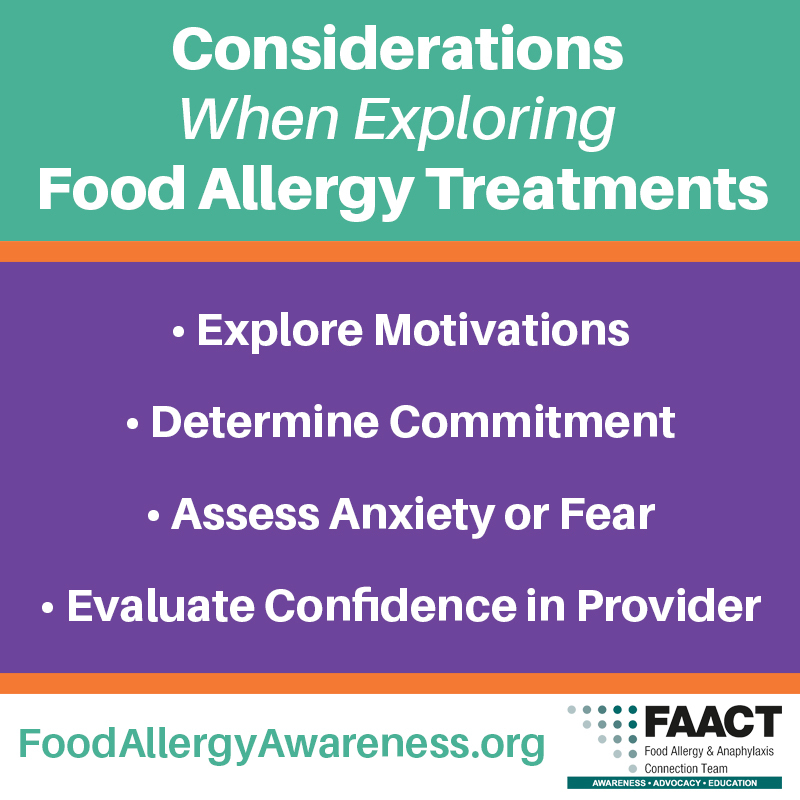
Considerations When Exploring Food Allergy Treatments
Explore Motivations:
Explore your and your child’s motivations for undergoing treatment. While the reasons may differ, it’s important to continually assess everyone’s motivation throughout treatment, as they may change and impact commitment levels.
Determine Commitment:
Assess your and your child’s level of commitment, as this may help determine if treatment is a good fit, and even when to begin treatment. All food allergy therapies require significant commitment.
Assess Anxiety or Fear:
Assess anxiety prior to starting treatment. While experiencing anxiety and worry is normal before and during treatment, excessive anxiety prior to the onset may be a factor in deciding when to begin a treatment.
Evaluate Confidence in Provider:
Ask questions that will help determine your level of comfort and confidence in the board-certified allergist administering the treatment.
Evaluation Process Before Beginning Treatment
Before enrolling in a food allergy treatment, it’s important to gather enough information to help not only make the decision whether or not to pursue it, but also to evaluate the board-certified allergist providing the treatment. Below is a question guide to help navigate this evaluation process.
Treatment & Provider Information:
• What are the goals, expected outcomes, and specific protocols for treatment?
• Are oral food challenges required to confirm the allergy before starting treatment?
• Are oral food challenges required to determine effectiveness of the trearment?
• What is the follow-up or maintenance protocol after treatment?
• What is required of you/your child (i.e. appointment frequency, daily protocols)?
• Will treatment impact school, work, activities, or daily routines, and if so, how?
• How are viruses or illnesses navigated while taking part in the treatment?
• How does the provider address treatment-related anxiety that may arise?
• How familiar is the provider with the treatment?
Potential Benefits & Risks of Treatment:
• What are the potential risks and benefits of the treatment, medical or otherwise?
• Are anaphylactic reactions a potential risk of treatment?
• What are potential treatment setbacks, their likelihood, and how they are handled?
Office Procedures:
• Will appointments be with the provider, or associates within the practice?
• Is a provider on call 24 hours/day in case of emergencies?
Develop A Flexible Food Allergy Treatment Mindset
Experiencing rigid thoughts and actions is natural when faced with uncertainty, discomfort, and distress. However, flexibility, or the ability to adapt, is beneficial when navigating treatments.
The following tips can help establish a flexible mindset and approach to food allergy treatments:
• Establish open communication with your board-certified allergist and treatment team.
• Engage in shared decision-making to develop treatment timeline and goals.
• Understand that treatment is a process rather than just a desired outcome.
• Prepare for the possibility of setbacks, the need to alter approaches, or stop treatment
• Monitor anxiety levels, reaching out for counseling or support services if excessive.