Changing Values Should Not Mean Changing the Need for Safety
Subcategories
Changing Values Should Not Mean Changing the Need for Safety
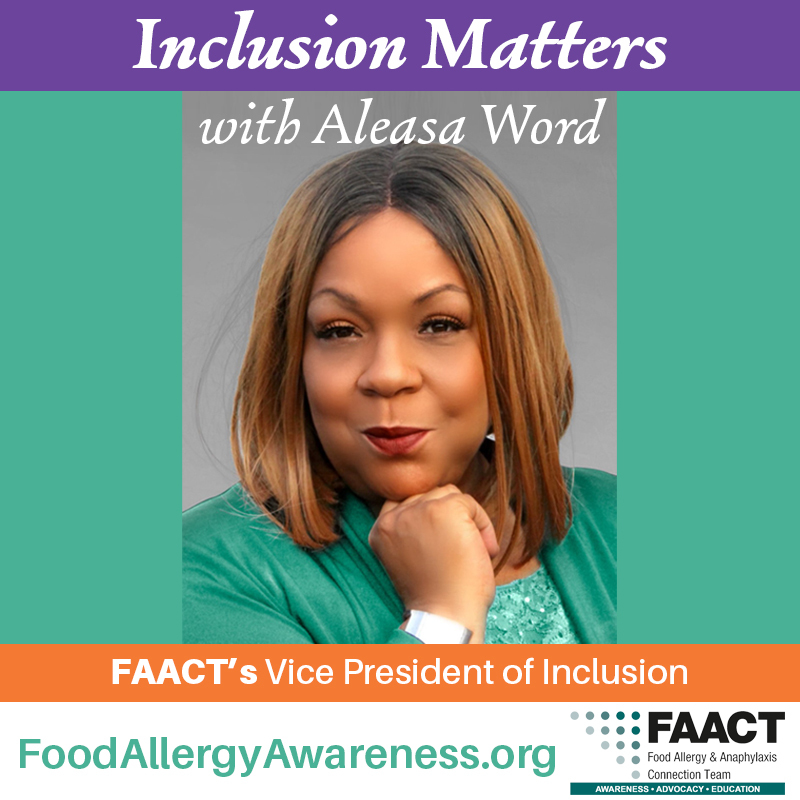
by Aleasa Word, FAACT Vice President of Inclusion Initiatives
June 2026
Every generation changes! Social norms change. Parenting styles change. Language changes. Technology changes. Expectations change. The workplace changes. Education changes. The way people date, communicate, celebrate, gather, and even disagree changes over time. Society is evolving, and that evolution is not always bad. Some changes reflect growth, awareness, and a deeper understanding of humanity.
But somewhere in the middle of all this change, something concerning has started happening. Basic safety is being treated like a preference instead of a responsibility, and food allergy safety is one of the clearest examples of this shift.
In May, we saw a lot of intentional awareness around food allergies for Food Allergy Awareness Month. However, it saddens me when I think about how often people living with food allergies are still forced to justify WHY safety matters. Not convenience. Not attention. Not trends. Safety! That should concern all of us.
During May, I shared my “3 Bucket Challenge,” which focused on knowledge, feelings, and action. The goal was simple. Help people understand food allergy awareness from multiple angles because not everyone learns the same way. Some people connect to facts. Some connect to emotion. Some connect to practical action steps they can immediately apply.
But underneath every tip was one deeper message: human beings deserve to feel safe. That should not be controversial or up for debate. Yet we live in a culture where people are increasingly encouraged to prioritize personal preference, personal comfort, and personal opinion over collective care and shared responsibility.
- When did asking about dietary restrictions before serving food become “doing too much” (or as young people phrase it, “doing the most”)?
- When did reading ingredient labels become something people mock as paranoia?
- When did carrying lifesaving medication become something people feel embarrassed about?
- When did accommodations become confused with inconvenience?
These are not just food allergy questions—these are humanity questions. Food allergy awareness is not only about ingredients. It is about empathy. It is about consideration. It is about critical thinking. It is about whether we can make room for other people without acting as though their needs are a burden to us.
Many people living with food allergies have learned to shrink themselves socially just to avoid conflict.
- Some stay silent at restaurants because they fear being labeled difficult.
- Some avoid gatherings altogether because they are tired of feeling like a problem.
- Some laugh off unsafe situations to avoid making other people uncomfortable.
- Some parents spend entire events scanning tables instead of relaxing because they know one careless moment could change everything.
And sadly, many people still do not understand the emotional toll that comes with constantly having to assess risk in environments that should feel safe. Imagine having to evaluate every meal, every snack, every school function, every workplace luncheon, every birthday party, every holiday gathering, and every social invitation through the lens of survival. It is exhausting.
A few days ago, I was just looking at my daughter as she went about her day. Of course, being her mom, I think she’s the most beautiful young lady in the world. But there was something else I thought of as she tried to find something to snack on. I thought about how exhausting it is every day not only for parents but for children who spend their lives learning to fit into a world that is often not willing to bend to fit them.
Why is the vulnerable person expected to carry the full emotional weight of safety alone? Food allergy awareness should never stop at awareness.
- Awareness without action becomes performance.
- Awareness without empathy becomes empty language.
- Awareness without behavior change helps very little in real-life situations.
Food allergies intersect with culture, religion, disability, mental wellness, healthcare access, family systems, and social belonging. Food is emotional. Food is communal. Food is deeply tied to identity and connection across the world. That is exactly why inclusion matters. Not because people are asking for perfection, but because people are asking for thoughtfulness. There is a difference.
No one is expecting every environment to be flawless. Human beings make mistakes. Restaurants get busy. Labels change. Cross-contact happens. Communication breaks down. And all of those can be dangerous for people living with food allergies. However, most if not all of these risks can be avoided when effort is in place. Effort still matters. Intentionality still matters. Listening still matters!
Safety should not disappear simply because society becomes more individualistic. If anything, this time in history requires us to become more community minded, not less. Food allergy awareness also challenges us to think bigger about how we respond to invisible needs overall.
So here are some questions I’ll leave you with to carry forward and keep the conversation going:
- Do we only care about people when their struggles are obvious?
- Do we dismiss needs that inconvenience us?
- Do we see accommodations as compassion—or annoyance?
- Do we create environments where people feel safe enough to speak up before a crisis happens?
- Have we become so consumed with defending personal freedom that we have forgotten personal responsibility?
There is room for both freedom and personal responsibility. We can value individuality while still protecting one another. We can honor personal choice while still practicing care. We can evolve socially without abandoning human sensitivity. The strongest communities are not the ones where everyone thinks alike. They are the ones where people understand that safety, dignity, and humanity should not be negotiable.
Maybe the conversation should not end with awareness ribbons, themed posts, or temporary campaigns. Maybe the real challenge is asking ourselves what kind of society we want to build moving forward. Do we want one where vulnerable people constantly adapt to everyone else? Or one where people willingly become more aware, more considerate, and more emotionally intelligent because they understand that community care matters?
Changing values should never mean changing the need for safety and something as simple as considering humanity.